
Glossary
The Grass Glossary
Plain-English meanings for sod, turf, grading and lawn-care words, so plans and quotes make sense.
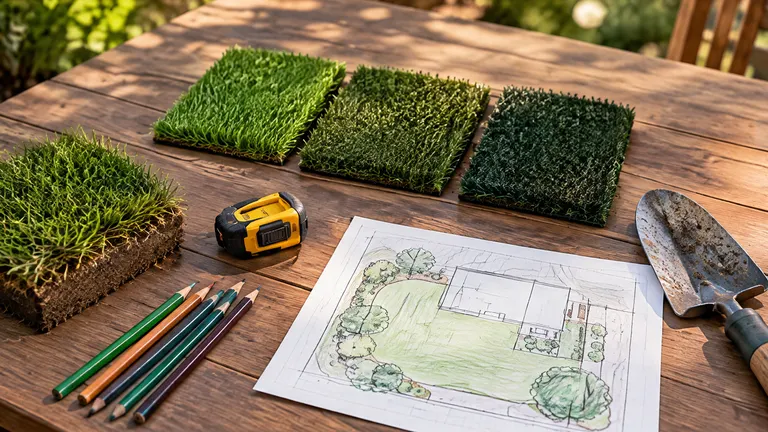
- Sod
- Strips or slabs of living grass, cut with a thin layer of soil and roots, laid on prepared ground for an instant lawn.
- Slab
- One piece of sod. Typical slabs or big rolls are laid in staggered rows.
- Pallet
- A stack of sod on a wooden base. One pallet usually covers about 450 square feet.
- Stagger
- Offsetting each row of sod by part of a slab so seams do not line up, like bricks in a wall.
- Seam
- The joint where two pieces of sod or turf meet. Tight seams hide best.
- Warm-season grass
- Grasses such as bermuda, zoysia, St. Augustine and centipede that grow best in heat and go dormant and tan in winter.
- Cool-season grass
- Grasses such as bluegrass and fescue that grow best in mild weather and stay greener through cold months.
- Transition zone
- The middle band of the country where summers are hot and winters are cold, so neither warm nor cool grasses are perfect.
- Dormant
- A resting state in which grass stops growing and turns tan, usually in cold winters or hot dry spells. It is not dead.
- Thatch
- A layer of old stems and roots between the soil and the green blades. A little is healthy, a lot blocks water.
- Grading
- Shaping the ground so it slopes gently away from the house and water does not pool.
- Subgrade
- The soil surface under a lawn or a turf base after grading and compacting.
- Base
- The compacted crushed stone layer under artificial turf that drains water and keeps the surface flat.
- Screed
- Dragging a straight board over the base stone to make it flat and even before turf goes down.
- Compaction
- Pressing soil or stone tight with a plate compactor so it does not settle later.
- Weed barrier
- A fabric laid under a turf base to keep weeds from growing up through it.
- Pile height
- How tall the turf blades are, from the backing to the tip, usually measured in inches.
- Face weight
- How many ounces of fiber are in a square yard of turf. More fiber means a fuller, longer-lasting surface.
- Stitch rate
- How many rows of stitches are sewn into the turf backing. Closer stitches look and feel denser.
- Backing
- The woven layers on the back of turf that hold the blades in and let water drain through.
- Infill
- Sand, cork or other granules brushed between turf blades to hold them up and the turf in place.
- Silica sand
- A rounded sand, heavy and firm, used as turf infill.
- Seam tape
- A strip glued under the edges of two turf pieces so the seam holds.
- Edging
- A firm border of timber, steel, stone or concrete that holds the edge of a lawn or turf in place.
- Overseeding
- Spreading grass seed over an existing lawn to thicken it and fill thin patches.
- Core aeration
- Pulling small plugs of soil from a lawn so air, water and nutrients reach the roots.
- Starter fertilizer
- A phosphorus-rich feed spread under new sod or seed to help roots grow.
- Irrigation zone
- A group of sprinklers on one valve, so different parts of a yard can be watered on their own schedule.
- Sod staple
- A small biodegradable pin that holds sod to a slope so it does not slide before it roots.
- Pet-ready turf
- Turf with a fully permeable backing and a drainage base, built so liquids pass through and odors can be rinsed away.
No term matches that search. Ask us, we are happy to explain.
Still have a question?
Ask us. We are happy to explain anything on a plan or a quote.